Daily Calorie Intake Calculator – How Many Calories Do I Need Per Day?
Calories are units of energy that fuel your body for daily activities like breathing, walking, and working. Whether your goal is to maintain weight, lose fat, or gain muscle, understanding how many calories you need each day is essential. A daily calorie intake calculator can help you estimate your personal energy needs and make smarter decisions toward your fitness goals. Maintaining the right calorie balance supports a healthy and energetic lifestyle.
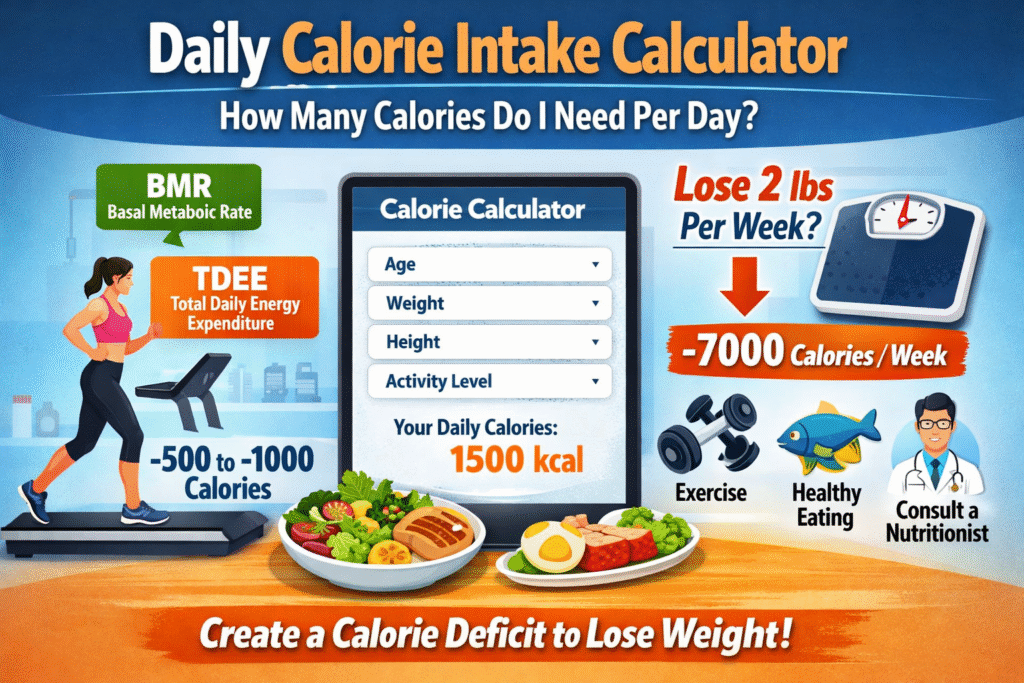
How many calories do I need to lose weight?
To lose weight, you need to consume fewer calories than your body burns each day. Researchers recognize this as a calorie deficit. Most experts recommend reducing your daily calorie intake by 500 to 750 calories. It can help you lose about 1 to 1.5 pounds per week safely and sustainably.
You need a specific calorie intake based on your age, weight, height, gender, and activity level. You can find out your personal needs with a daily calorie intake calculator. It will calculate your BMR and TDEE.
How Many Calories Should I Eat a Day to Lose 2 Pounds a Week?
Before diving into the science behind calorie consumption, let’s address a common question: How many calories should I eat to lose weight, particularly 2 pounds a week?
To understand this, you need to know that weight loss essentially comes down to creating a calorie deficit, meaning you consume fewer calories than your body needs for daily functions and activities. A pound of fat is roughly equal to 3,500 calories. To lose 1 pound, you need to burn 3,500 more calories than you consume.
How to Create a Calorie Deficit
If you want to lose 2 pounds a week, you need to eat 7,000 fewer calories than you need (3,500 x 2). It means you need to eat 1,000 fewer calories each day for seven days.
Let’s take a closer look at how to figure this out:
If you need 2,500 calories a day to keep your weight stable (your Total Daily Energy Expenditure or TDEE), you should try to eat 1,500 calories a day to make up the difference.
Your body will use stored fat as energy if you eat 1,500 calories a day and burn 2,500 calories through your BMR and activity. It will help you lose weight.
But is it safe to lose 2 pounds a week?
It may be tempting to lose weight quickly, but you should keep in mind that cutting calories too much can harm your metabolism, muscle mass, and overall health. Most of the time, it’s safer and more sustainable to lose 1 to 1.5 pounds a week. When you lose weight quickly, you often lose muscle and nutrients, which makes it harder to keep the weight off in the long run.
It’s a good idea to talk to a doctor or nutritionist before starting any weight-loss plan to ensure it’s safe.
How many calories should a woman eat every day to lose weight?
Women need different amounts of calories depending on their age, weight, height, level of activity, and metabolic rate. Women usually need fewer calories than men because their bodies and muscles are different. Women need to eat about this many calories every day to keep their weight:
- Women who don’t move around much need 1,800 calories.
- Women who are moderately active need between 2,000 and 2,200 calories.
- Active women need 2,400 calories.
Women usually need to eat 500 to 750 fewer calories each day to lose weight. It can help them lose about 1 to 1.5 pounds per week. It would mean they would eat about 1,200 to 1,500 calories a day.
Women Who Don’t Move
Women who don’t do much physical activity usually need 1,800 calories a day to maintain their weight. Eating between 1,300 and 1,500 calories a day can help you lose weight by creating a healthy calorie deficit.
Somewhat Active women
Women who engage in moderate exercise or physical activity, such as walking, biking, or household chores, usually need between 2,000 and 2,200 calories a day. A daily intake of 1,500 to 1,700 calories may be enough to help you lose weight.
Active women
Active women who engage in strenuous exercise or work in physically demanding jobs may need 2,400 calories or more. To lose weight, they could eat between 1,700 and 2,000 calories a day.
How to Calculate Your Daily Calorie Needs (BMR & TDEE)
You might be asking yourself, “How do I know how many calories I need?” The answer is to figure out your Basal Metabolic Rate (BMR), which is the number of calories your body needs to do basic things like breathe, digest food, and keep your body temperature stable while you sleep.
You can use a daily calorie intake calculator to estimate your calorie needs based on your weight, height, age, and activity level. This tool can help you quickly figure out how many calories you need to consume each day to maintain, lose, or gain weight.
If you prefer to calculate it manually, the Mifflin-St. Jeor’s equation can help you figure out your BMR:
For Men:
BMR = 10 × weight (kg) + 6.25 × height (cm) – 5 × age (years) + 5
For Women:
BMR = 10 × weight (kg) + 6.25 × height (cm) – 5 × age (years) – 161
You can figure out your Total Daily Energy Expenditure (TDEE) after you know your BMR. It is the total number of calories your body burns in a day, taking into account your level of activity. To find your TDEE, multiply your BMR by an activity factor:
- Sedentary (little or no exercise): BMR × 1.2
- Lightly Active (doing light exercise or sports 1–3 times a week): BMR × 1.375
- Moderately Active (moderate exercise or sports 3–5 days a week): BMR × 1.55
- Very Active (hard exercise or sports 6–7 days a week): BMR × 1.725
- Super Active (very hard work, physical job, or training twice a day): BMR × 1.9
For example, a 30-year-old woman who weighs 70 kg, is 165 cm tall, and works out 3 to 5 days a week. We first figure out her BMR:
BMR = 10 × 70 + 6.25 × 165 – 5 × 30 – 161
BMR = 700 + 1,031.25 – 150 – 161.
BMR = 1,420.25 calories/day
Then, we find her TDEE by multiplying her BMR by 1.55, which is a moderately active activity level:
TDEE = 1,420.25 × 1.55 = 2,201.4 calories per day
She would need about 2,201 calories a day to maintain her weight. If she wanted to lose weight, she could try to eat 1,500 to 1,700 calories a day.
How many calories do I burn each day?
Your Basal Metabolic Rate (BMR), your level of activity, and the thermic effect of food (the energy needed to digest food) all play a role in how many calories you burn each day.
As we discussed before, your TDEE accounts for all of these factors, giving you a better idea of how many calories you burn each day. The TDEE has:
- BMR: Calories burned while at rest
- Calories burned through exercise and other physical activity
- The thermic effect of food is the number of calories burned during digestion.
If your TDEE is 2,200 calories, that means you burn 2,200 calories every day, accounting for your level of activity and your body’s energy requirements. If you want to lose weight, you need to eat fewer calories than your TDEE (total daily energy expenditure).
Conclusion
Using a calorie counter daily can help you track your food intake and stay consistent with your goals. Instead of guessing how much you are eating, a daily calorie intake calculator allows you to quickly estimate your personal energy needs based on your weight, height, age, and activity level.
While some people manually calculate their BMR and TDEE, using a reliable calorie tool makes the process easier and more accurate. If you are looking for a simple and effective solution, you can use the James Smith Calorie Calculator to estimate your daily calorie needs and create a plan that fits your fitness goals.
Frequently Asked Questions (FAQs)
Q. What is a daily calorie intake calculator?
A daily calorie intake calculator is an online tool that estimates how many calories your body needs each day based on your age, weight, height, gender, and activity level. It helps you determine whether you should eat more, less, or maintain your current intake.
Q. How accurate is a calorie counter daily?
A daily calorie counter provides an estimate based on scientific formulas such as BMR and TDEE. While it may not be perfect, it provides a reliable starting point for managing weight and tracking progress.
Q. How many calories should I eat to lose weight safely?
Most experts recommend creating a 500- to 750-calorie daily deficit. It typically helps you lose about 1 to 1.5 pounds per week, which is considered safe and sustainable.
Q. Is losing 2 pounds a week healthy?
Losing 2 pounds per week is possible, but it requires a large calorie deficit. For many people, a slower, steadier approach to weight loss is healthier and easier to maintain over the long term.
Q. What is the difference between BMR and TDEE?
BMR (Basal Metabolic Rate) is the number of calories your body burns at rest.
TDEE (Total Daily Energy Expenditure) includes BMR plus calories burned through activity and digestion.
Q. Can I use a calorie counter instead of manual calculations?
Yes. Instead of manually calculating BMR and TDEE, you can use a reliable calorie counter or daily calorie intake calculator to estimate your needs and save time quickly.